Keel · Guides · Insights & Records
Why there is no comparison
It says no comparable reading.
No comparable reading yet means one span has no eligible, already-due occurrences.
AvailabilityPro feature — readable on Free
No comparable reading yet means one span has no eligible, already-due occurrences. Although the message says "settled doses", unlogged due occurrences also count. A span with eligible doses but none taken can show 0 of n; missing data is different from zero taken.
Windows
The current span includes today: it runs from the start of the day 6 (or 29) days ago to now; the prior span starts one full span earlier and is cut to exactly the elapsed interval the current span has run, so the two always cover equal time. Progress's rolling windows are different, which is why the two screens can disagree on the same day.
Unavailable vs zero
Both spans need eligible due occurrences. If either has none, the pair is unavailable, including the logged-late comparison. When eligible rows exist, no taken logs gives zero taken; no late logs gives zero late.
Steps
- Under Patterns, choose Range — 7 days or 30 days (remembered).
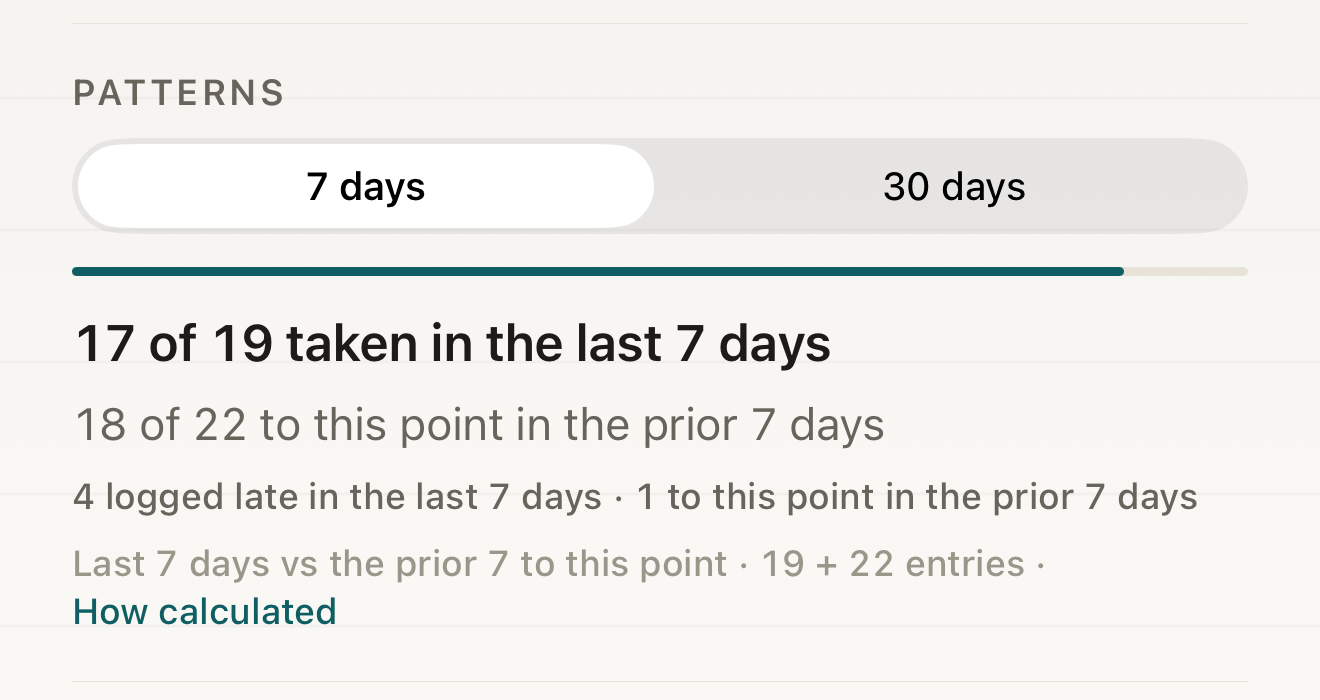
Fictional record with Pro: the current span against the same span before it, and the link to how each number was calculated. DisclosureA Pro screen on the real clock; the numbers are the fixture’s own and change with the capture day.
- Range
- taken line
- prior-span line
- How calculated
Where this screen comes from
- File
E3-F1-patterns.png(1320×700);E3-F1-patterns.webpis a lossy encode of it- Derivative SHA-256
1204ce969f529f8283d0f5339d6495fc4211605762dc54afd29379796d38de9b- Source
E3-F1.pngin packageKeel-WT-7e41269-guide-figures-B3-20260924-113146-8354- Source SHA-256
8dcd3ea6c059f2dea152bfecce127222ba4ad6509d2aff9a508cf5a809674629- Package seal
cf5364a44a6ef64b3262580c6efc582072c104c37e70f96070f9c35ac6d4c167- Captured from
- Keel 1.0.0 (1), implementation
working tree 7e41269 (NOT a candidate; head 7e4126919da3a44a9ad2f2efaf3ad2467c1fbff7, build-input tree c863167fe1474c471d3562fe90f5f107c9598edff3903cdfc58b89bc7ae3032c, build build-20260924-111522-2644) - Operation
- crop x0 y430 w1320 h700 (source pixels, origin top-left)
The numbered markers are drawn by the page, not into the image.
- Read the lines: "n of n taken in the last 7 days", "n of n to this point in the prior 7 days", "n logged late in the last 7 days · n to this point in the prior 7 days".
- Tap How calculated on the provenance line ("Last 7 days vs the prior 7 to this point · n + n entries"). The sheet states Calculated <date time>, then per metric — Adherence "Taken over settled due occurrences", Logged late "Settled late occurrences" — the definition id and version, This span and Prior span with their exact date-time ranges and "n records", any exclusions, "No records excluded", and "Sources updated through <date time>". Close.


- Calculated
- Taken over settled due occurrences
- This span / Prior span ranges
Where this screen comes from
- File
E3-F2-how-calculated.png(1320×940);E3-F2-how-calculated.webpis a lossy encode of it- Derivative SHA-256
dd9f1f3fd54b5cf550a6a728d6d7b9e3135b7adc2a1897f40691043ddd3e2e7b- Source
E3-F2.pngin packageKeel-WT-7e41269-guide-figures-B3-20260924-113146-8354- Source SHA-256
3accffe5ee5a62bbe4f7b275ac387f5978c09b86caacf9f644590ae92b83e643- Package seal
cf5364a44a6ef64b3262580c6efc582072c104c37e70f96070f9c35ac6d4c167- Captured from
- Keel 1.0.0 (1), implementation
working tree 7e41269 (NOT a candidate; head 7e4126919da3a44a9ad2f2efaf3ad2467c1fbff7, build-input tree c863167fe1474c471d3562fe90f5f107c9598edff3903cdfc58b89bc7ae3032c, build build-20260924-111522-2644) - Operation
- crop x0 y200 w1320 h940 (source pixels, origin top-left)
The numbered markers are drawn by the page, not into the image.
If it looks different
- "n records excluded"
- the sheet names predates tracking (unlogged occurrences before the routine's creation day) or unresolved ledger (history awaiting resolution). Logged backfills are not excluded merely for predating tracking. Supply-profile exclusions belong to other metrics, not this Patterns sheet.
- Free tier: Patterns shows the Example sample ("12 of 13 taken in the last 7 days", "2 logged late")
- not your record.
A comparison is arithmetic over eligible due occurrences in two equal spans; Keel never turns it into a verdict.